2720 Faucette Drive
3229 Jordan Hall Addition
NC State University
Raleigh, NC 27695-8008
Phone: 919.515.6424
Fax: 919.515.6430
camcore@camcore.org
Left Navigation
- Home
- Overview
- Gene Conservation
- Tree Breeding
- Projects
- Publications
- Membership
- Member Login
- Join and Donate Now
Please consider an online gift. Every dollar goes directly to our work
conserving forest tree species in the tropics and subtropics.
Recent and Ongoing Projects
 recent and Ongoing Projects
The following are projects that Camcore is currently working or has recently completed. Your financial contribution helps Camcore achieve its mission “To be a world leader in tree improvement and conservation of forest resources for the benefits of industry, society and environment”.
- Gene Conservation of Red Spruce and Fraser Fir in the Southern Appalachian Mountain
- Near infrared technology used to distinguish among eucalypt clones from Indonesia
- Camcore exams why wood density varies in E. urophylla populations.
- Low levels of introgression found in natural populations of P. jaliscana in western Mexico.
- Measuring growth rhythms in Pinus maximinoi.
- Camcore goes on to nect stage of Work with E. pellita from Indonesia
- Camcore work with Teak Continues
- Gene Conservation of Atlantic White Cedar in the Eastern United States
- Conservation of hemlock species in the eastern USA
- Genetic Conservation of Table Mountain Pine in the Southern Appalachians
- Evolutionary
history study of Pinus oocarpa
Gene Conservation of Red Spruce and Fraser Fir in the Southern Appalachians
The high-elevation red spruce (Picea rubens) and Fraser fir (Abies fraseri) forests of the Southern Appalachian Mountains are among the most threatened ecosystems in North America. Occurring in scattered populations at elevations of 1,300 to 1,500 m (4,500 to 5,000 ft) and 1,600 m (5,500 ft) and above, respectively, both species are in decline due to extensive logging operations and related wildfires in the Appalachian region during the early 1900s followed by the invasion of the exotic insect pest balsam woolly adelgid (BWA, Adelges piceae). Since the 1950s approximately 70% of all remaining Fraser fir has succumbed to BWA. More recently, air pollution has caused further reductions in population size of both species. Reports of reductions of once vast spruce-fir forests that encompassed an estimated 600,000 ha (1.5 million ac) in West Virginia alone in 1865, are now restricted to less than 37,000 ha (90,000 ac) (red spruce) and 20,000 ha (50,000 ac) (Fraser fir) across the Southern Appalachian Mountains.
In 2014 Camcore received a grant from the USDA Forest Service Southern Region Forest Health Protection to conserve germplasm from remaining populations of both red spruce and Fraser fir. This two year project aims to collect material from 400 mother trees of red spruce from 20 populations. For Fraser fir our goal is to secure seed from 240 individual trees across the seven major populations of the species. While 2014 was a poor year for cone production we made progress with Fraser fir with the donation of seed from the North Carolina Christmas Tree Growers Association Cooperative Seed Orchard. Ultimately, all seed collected will be distributed among three seed repositories. The USDA National Center for Genetic Resources Preservation in Fort Collins, CO will received 500 seeds from each mother tree for long-term preservation. The remaining seed will be split evenly between the USDA Forest Service Ashe Seed Facility in Brooklyn, MS and the Camcore Seed Bank in Raleigh, NC and used to meet conservation objectives related to seed storage, seed orchard establishment, and reforestation project.
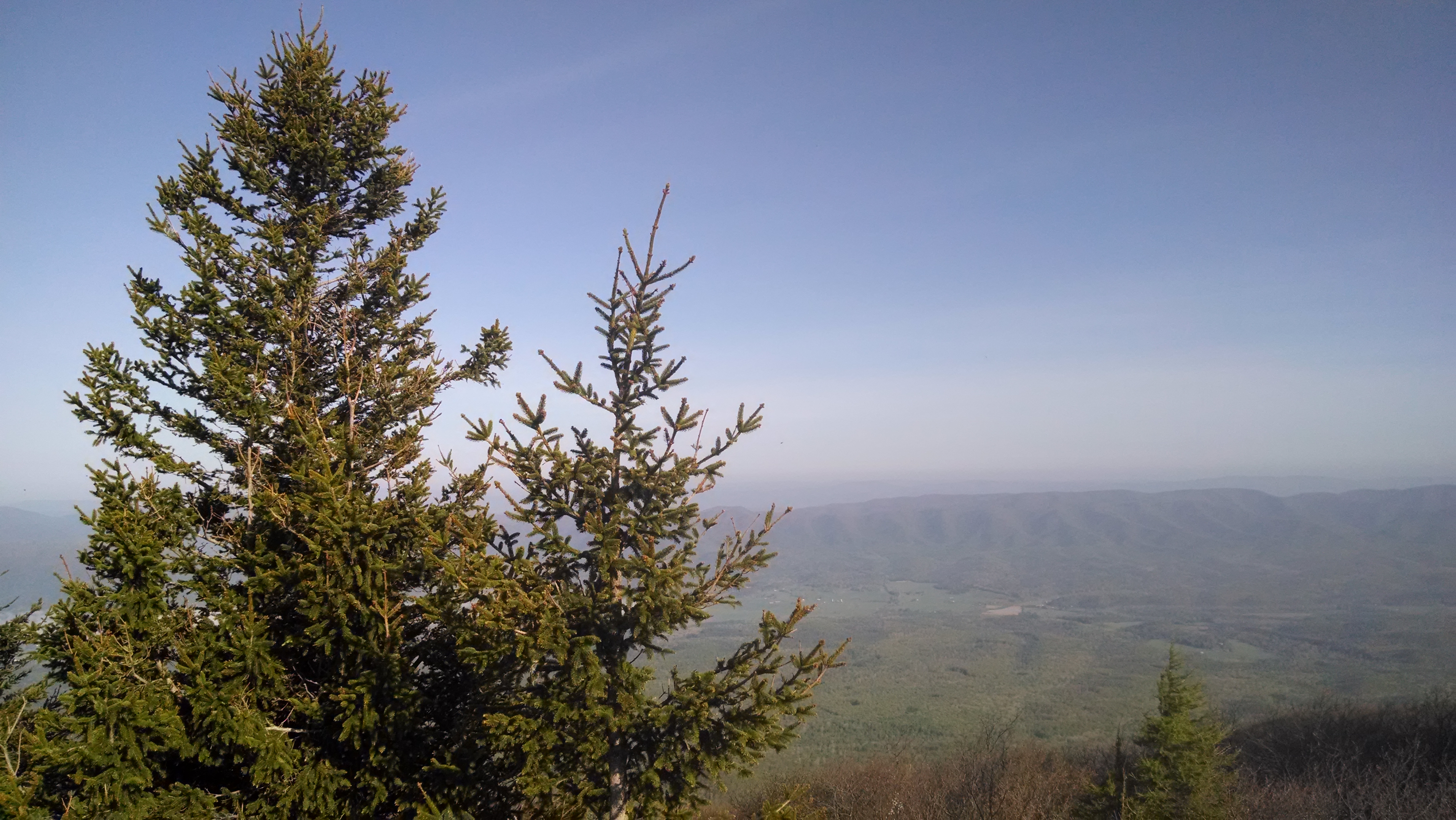
High elevation red spruce stand in Virginia, US.
Near infrared technology used to distinguish among eucalypt clones
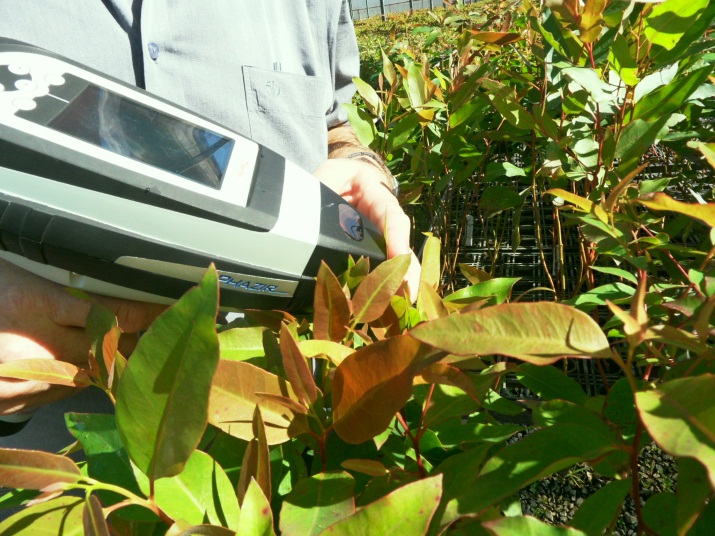
Hand held NIR device scanning eucalypt leaves in the nursery.
Camcore has used near infrared spectroscopy (NIRS) as a cost efficient way to quantify differences in chemical properties in wood and to verify hybridity in pines. One of the current projects underway is to determine if NIRS can be used to distinguish eucalypt clones in the nursery. Often times in commercial tree nurseries, 3-10 clones are propagated operationally for field planting. This might include thousands of copies of one clone in a number of nursery beds. To maximize matching the right clone to the right site, nursery managers must ensure that clones are correctly labeled in the nursery prior to field planting. NIRS might offer a way to confirm clonal identity. Camcore and CSIRO (Australia) are working together with a hand-held and desktop NIRS to determine if the devices can distinguish among clones. The hand-held device scans green leaves of a clone and these spectral signatures are compared to other clones. Results from the hand-held device are then compared to dried leaf samples on a table top NIRS, which has a broader wavelength capability. If using a hand-held device to distinguish individual clones in the nursery is feasible, it will offer important technology to confirm that the right clone is being planted where it should be in the field.
Camcore exams why wood density varies in E. urophylla populations
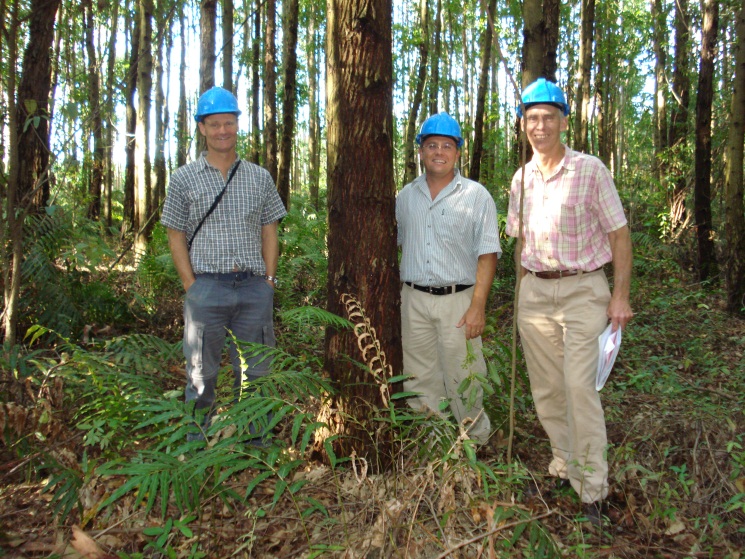 Camcore E. urophylla trials planted across continents provide useful information on the physical and chemical properties of wood.
Camcore made seed collections of Eucalyptus urophylla in seven islands in the Sundra Archipelago of Indonesia between 1996 and 2003. We have now established over 100 field trials in Latin America and Africa. One of the things that we have learned is that wood density varies greatly in the progeny depending on what island the original seed collections were made. Furthermore, we found that there was an inverse relationship between wood density and pulp yield. We are now testing the hypothesis that this inverse relationship is the result of high amounts of lignin in the trees (high density=low pulp yields). At this time, we are not sure why the amount of lignin differs greatly in E. urophylla depending on the island of collection.
Low levels of introgression found in natural populations of P. jaliscana in western Mexico.
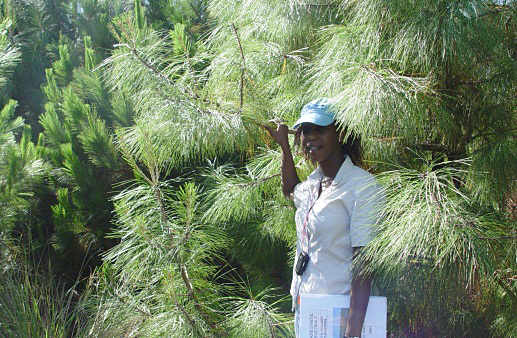 Putative P. jaliscana x P. oocarpa hybrid in the foreground and typical P. jaliscana in the background in a progeny test established in South Africa.
Camcore has used traditional botanical analysis of needles and cones of P. jaliscana and P. oocarpa in natural stands in western Mexico to confirm that there are low levels of introgression (hybridization) occurring between the two species. It used a combination of botanical assessment and near-infrared spectroscopy of oven-dried needles from a 10-year-old P. jaliscana progeny trial planted in South Africa to verify that some P. jaliscana x P. oocarpa offspring occur among the pure P. jaliscana trees. The species-wide introgression rate in P. jaliscana was estimated at 2.3%. NIRS provides a quick way to obtain reasonable estimates of species admixtures in progeny trials and is an inexpensive surrogate to using molecular markers.
Measuring growth rhythms in Pinus maximinoi
P. maximinoi is one of the fastest growing species in our portfolio of pines. In Africa, we have established test plantings of the species from approximately 4°S to 34°S latitude. This project attempts to determine if P. maximinoi ever sets a resting bud in the various locations that it is planted. Knowing something about the growth rhythms of this species might help us explain trends in its productivity versus other pines. Seven members have placed dendrometer bands around young P. maximinoi trees and a control species to monitor bi-monthly circumference increment and shoot elongation. The study will last one-year to exam the correlation between circumference growth and shoot elongation patterns.
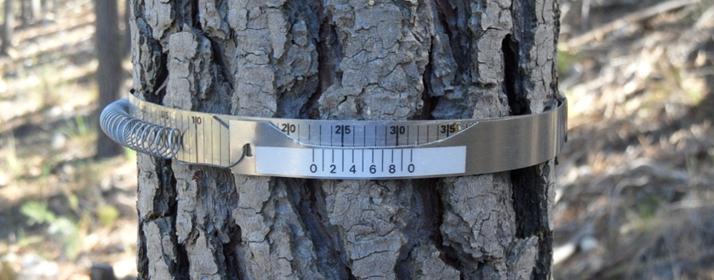 Dendrometer band around a tree to measure circumference increment over time.
Camcore begins next stage of work with Eucalyptus pellita in Indonesia
 Tree climber makes a difficult seed collection in an E. pellita tree in a remote area of eastern Indonesia (Photo courtesy of PT Sumalindo Lestari Jaya).
Eucalyptus pellita is a tropical species native to Papua, Indonesia, Papua New Guinea and Queensland, Australia. Even though much work has been done in the conservation and testing of tree populations from Papua New Guinea and Australia, little work has been conducted on region-wide sampling of the species in eastern Indonesia. In 2009 Camcore and its member PT Sumalindo Lestari Jaya began work to sample some of the most remote populations of the E. pellita in Papua, Indonesia. This first seed collection sampled 6 populations and 99 mother trees. The genetic material has been distributed to Camcore members in Latin America and Africa for provenance/progeny testing and the development of ex situ conservation banks in 2010.
Camcore continues Work with Teak
 Collection of Teak seed by Camcore member “East
Africa”. Seeds from trees like these in Tanzania
will be included in the first international trial series.
(Photo courtesy of TAFORI)
Camcore members have completed an exchange of Teak seeds as part of our effort to broaden the genetic base of Tectona grandis. Participating in this Teak exchange are companies in Australia, Colombia, Costa Rica, Guatemala, Indonesia, Mozambique, Tanzania and Venezuela. Participating members from each of these countries have begun to establish progeny trials that will be analyzed by Camcore. Our initial goal is to establish approximately 20 trials across these eight countries in the first series of tests. From these trials we will identify the genetically best trees, which will then be selected and moved onto the next cycle of breeding. Seeds by family have also been obtained from Bangladesh as well as bulk lots from India.
Check out our Teak and Gmelina Newsletter for more on our work with Teak.
Gene Conservation of Atlantic White Cedar in the Eastern United States
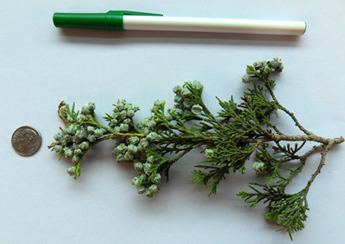 Atlantic White Cedar Foliage and Cones from the Croatan National Forest, North Carolina.
Atlantic white-cedar (AWC, Chamaecyparis thyoides) is a cypress species (family Cupressaceae) endemic to the fresh water swamps and bogs of the Atlantic and Gulf coasts of the United States. Prior to European settlement, there were an estimated 202,000 ha of AWC swamps and wetlands in the eastern United States, but today only about 40,000 ha remain, restricted to a relatively small number of small dense stands. AWC swamps are of ecological significance, particularly with respect to their role in hydrological processes. AWC swamps stabilize stream flows, store flood waters, help to mitigate the effects of drought, and filter and purify water as it flows through them. They are also home to a great diversity of plant, mammal, amphibian, and bird species, many of them rare and/or threatened and some that are obligates to AWC habitats. With growing public awareness of the importance of these unique wetland ecosystems, efforts to regenerate or restore AWC swamps have increased in the last 20 years. Given the decline of AWC, its patchiness across the range, its exacting site requirements, and its ecological and economic importance, the species is a good candidate for seed collection and genetic resource conservation efforts. Camcore began working on an AWC gene conservation project with funding from associated member USDA Forest Service in 2011. This three year project will sample seed from a total of 400 mother trees across 40 remnant populations. Seed collections will be made from 10 mother trees in 10 populations in each of four seed zones that have identified for the species using the FloraMap™ climate model.
Gene Conservation of Eastern and Carolina Hemlock
 |
Jaime Zapata from Bioforest-Arauco holds a healthy Carolina hemlock seedling in Chile. |
Since 2003, Camcore has been working on a cooperative gene conservation project for Eastern (Tsuga canadensis) and Carolina hemlock (T. caroliniana) with the USDA Forest Service. These ecologically important tree species are native to mountain ecosystems in the eastern United States and both face a significant threat from the Hemlock Woolly Adelgid (HWA, Adelges tsugae). HWA is an exotic insect pest native to Japan that was introduced to the eastern US in 1951 and has since caused widespread decline and mortality of both tree species. The objective of this project is to maintain, in perpetuity, viable seed reserves and plantations of both species that will be available for breeding and restoration efforts once effective HWA management strategies are in place. Since starting this work, Camcore has made significant progress in seed collection, with seeds sampled from 407 mother trees in 59 populations of Eastern hemlock and 126 mother trees in 18 populations of Carolina hemlock. Seeds have been placed into cold storage for long-term preservation at seed repositories in Raleigh, NC (Camcore) and Fort Collins, CO (USDA-ARS-National Germplasm Repository) and conservation plantations have been established in Brazil (Camcore member Rigesa), Chile (Camcore member Bioforest-Arauco), and the US. The USDA Forest Service is an associated member of Camcore and has provided the bulk of the funding for this project.
Gene Conservation of Table Mountain Pine in the Southern Appalachian Mountains
 |
Table Mountain Pine surrounded by Virginia Pine at Hanging Rock State Park, North Carolina. |
Table Mountain Pine (TMP, Pinus pungens) is a Central and Southern Appalachian Mountain endemic that requires periodic wildfire to release seeds from highly serotinous seeds cones and prepare the soil for seed germination. Throughout the geographic range populations have declined significantly over the last several decades due to wildfire suppression programs and periodic outbreaks of the Southern Pine Beetle (Dendroctonus frontalis). Today, fewer than 12,000 ha of TMP forest remain with trees mostly restricted to dry rocky ridgelines. In 2009, Camcore associate member USDA Forest Service provided funding for a 3 year project to conserve dwindling gene pools for the species and provide a source of germplasm for reforestation efforts. Seeds have been collected from 213 mother trees in 31 TMP populations. In total, more than 400,000 seeds were rescued with nearly half residing in cold storage for long-term preservation at seed repositories in Raleigh, NC (Camcore) and Fort Collins, CO (USDA-ARS-National Germplasm Repository). 200,000 seeds have been provided to the USDA Forest Service for the establishment of seed orchards and reforestation programs. In 2012, the USFS provided an additional year of funding to further sample regions in southwestern Virginia and Pennsylvania that are under-represented in the initial seed collection and to conducted studies on the population genetic structure and diversity and recent evolutionary history of TMP.
Evolutionary history study of Pinus oocarpa
 Phylogenetic tree evolved from the progenitor Oocarpa showing relation between different subsections of Mexican Pines
We have recently completed an evolutionary history study of Pinus oocarpa, which has a geographic range of 3000 km (1860 miles) from Mexico to Nicaragua, using microsatellite markers. The study included 50 seed samples from provenances that covered the entire geographic range of P. oocarpa. Also included were provenances of P. tecunumanii and P. patula. We confirmed that P. oocarpa from Central America was the progenitor of P. tecunumanii. We also verified that there are high levels of gene exchange between provenances of P. oocarpa and P. tecunumanii in some locations in Central America and between P. oocarpa and P. patula in isolated regions in eastern Mexico.